


Investing in data and improving governance are widely recognised as the keys to closing the performance gap in franchised bus networks. But knowing what's needed and knowing how to operationalise it are two different things. What does effective contract and performance management actually look like in practice? And what does the right set-up require?
The answer rests on five interconnected pillars that empower transport authorities to proactively manage franchised network performance. In this post, we'll outline each one and explain how, together, they enable transparent contract and performance management that accurately reflects what's happening on the road.
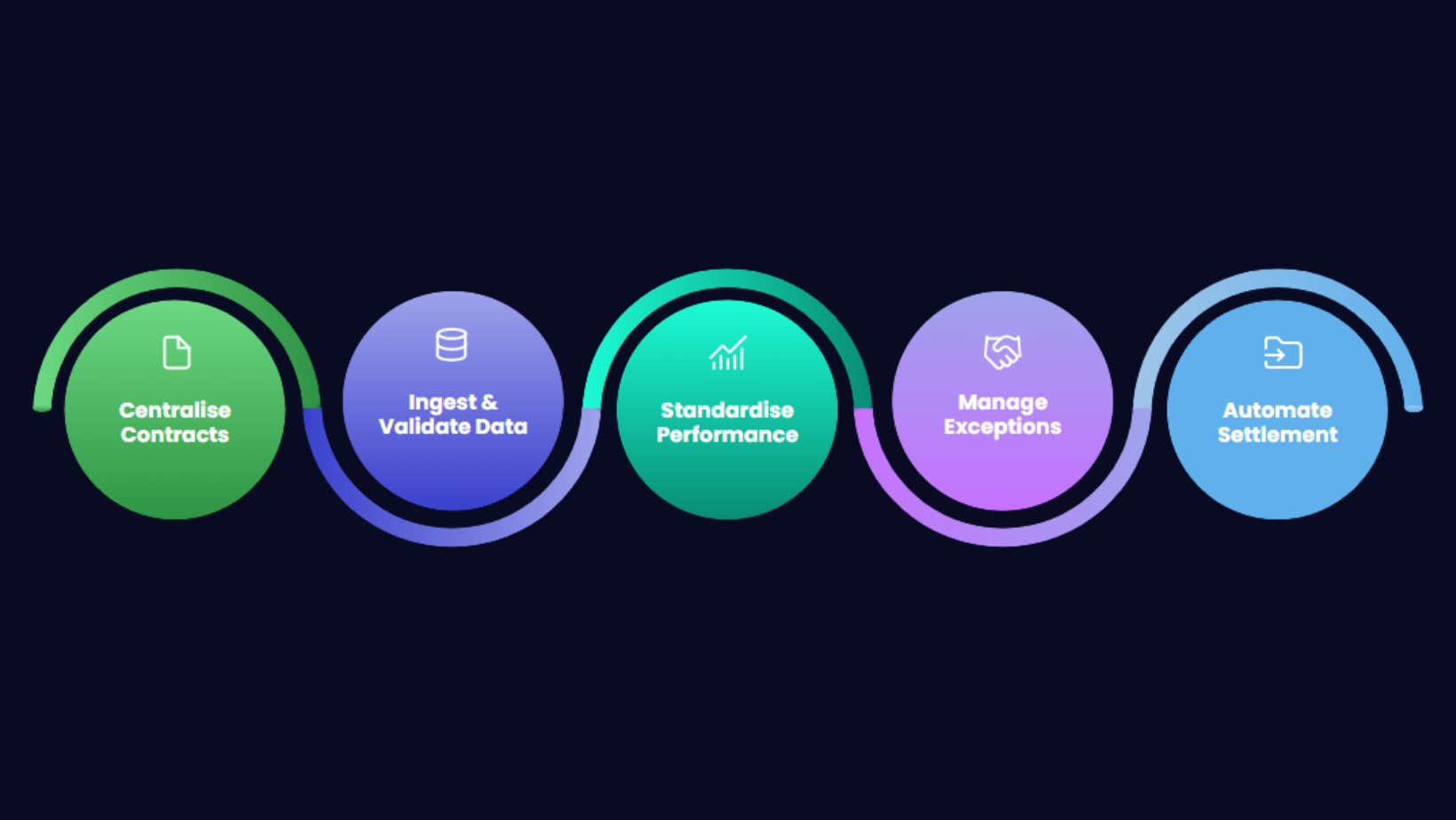
Pillar One: A centralised, auditable contract repository
In many transport networks, contracts and their associated variations are distributed across multiple systems and departments. The result is version control risk, information gaps, and, when performance issues arise, an authority that cannot confidently point to a single source of “commercial truth”. And that commercial truth is vital for achieving fair accountability, consistent enforcement, and genuine collaboration between authority and operator.
Having a centralised, secure contract repository provides the starting point from which everything else flows. KPIs, financial terms, and performance regime standards must be consistently and accurately surfaced to the teams responsible for measuring them. If the people running performance reviews are working from different versions of a contract, no amount of sophisticated data analysis will produce reliable outcomes.
Equally important is traceability. Contract changes, from variations to amendments and everything in between, must be logged with full audit trails that enable the authority to confidently demonstrate a clear record of each contractual decision.
Pillar Two: Continuous, automated data ingestion
You cannot manage what you cannot measure. And you cannot measure what you cannot trust.
The data feeding a performance management system is only as reliable as the processes used to ingest, cleanse, and validate it. For most newly franchised authorities, inheriting fragmented systems from multiple operators, each configured differently, each producing data in different formats, creates the first challenge in accurately managing contract performance.
Effective data ingestion is not a one-off exercise. It requires continuous automated import, standardisation across formats, and intelligent detection of anomalies and duplicates. Without this layer, even the most sophisticated KPI calculations are built on unreliable inputs, producing outputs that neither authorities nor operators can trust.
Authorities need full traceability from raw input to final calculated output to be able to effectively understand network performance, and maintain operator confidence.
This empowers both authorities and operators to move from approximate, point-in-time snapshots of performance to a continuous, auditable record of what is actually happening within the network.
Pillar Three: Accurate, contract-aligned KPI calculation
Performance measurement must reflect contractual reality, not operational guesswork.
Many authorities are attempting to measure KPIs using systems that were never designed for contractual reporting. The result is a performance regime built on estimates rather than verifiable fact.
Robust KPI calculation requires contract-specific rule sets, based on logic that reflects each contract's specific definitions, thresholds, and measurement periods, rather than generic industry benchmarks applied uniformly across the network. What counts as a missed journey under one contract may be defined differently under another. The system must know the difference and apply the correct logic automatically.
Transparency is equally important. Both authorities and operators need to be able to drill down from headline scores to the underlying data that produced them. The goal is not just accuracy, but a record of performance that both authority and operators trust. This transforms performance from subjective interpretation to a matter of fact, with clear, traceable logic connecting every data point to every financial outcome.
Pillar Four: Manage exceptions with evidence
One of the most friction-laden and resource heavy aspects of franchised bus management is the handling of performance exceptions: delays caused by road closures, extreme weather, third-party incidents, or other factors genuinely outside an operator's control. Without a structured, evidence-based process for submitting, reviewing, and resolving these situations, they fall into the performance gap.
Effective performance issue reviews require clear, consistent workflows. Operators submit exceptions with supporting evidence. Authorities review against defined criteria. Decisions are logged with full audit trails. Both sides work from the same information and understand the basis for the same outcomes.
This matters beyond the immediate operational efficiency gains it delivers. How disputes are resolved shapes the long-term relationship between authority and operator as much as the outcomes themselves. Transparency in exception handling is just as important as accuracy in KPI measurement.
Using data and intelligent automation to identify and diagnose performance issues reduces both the cost and the workload involved. It also creates a more collaborative process, enabling authorities and operators to work together to find the best solution.
Pillar Five: Automated, accurate payment calculations
The ultimate benefit of a contract and performance management system is payment based on what really happened on the road. If contract performance calculations are disconnected from verified data, relying instead on manual calculation, spreadsheet exports, and contested figures, the entire governance framework loses its integrity at this final step.
Automated financial settlement, where deductions, bonuses, incentives, and penalties are calculated directly from KPI outcomes and accepted exceptions, removes the subjectivity and manual effort that currently make this process vulnerable to challenge. When settlement takes weeks to reconcile, it introduces a lag between performance and consequence that undermines the incentive structure the contract was designed to create.
Most importantly, both authorities and operators must be able to access clear, itemised breakdowns of how performance outcomes translate into financial figures. Ambiguity in financial settlement is one of the fastest ways to erode trust.
Financial accuracy and timeliness are not just operational efficiencies, they’re governance responsibilities. Public funds must be allocated on the basis of verified performance, not estimated activity.
Moving from financial settlement as a subjective accounting exercise to an automated, transparent, and trusted outcome of the performance management process benefits all stakeholders.
Why integrating the pillars matters
Each of the five pillars is necessary — but none is sufficient on its own. An authority with a strong contract repository but weak data ingestion will produce unreliable KPIs. Accurate KPIs without structured exception handling will generate disputes. Transparent exceptions without automated settlement will slow financial resolution and frustrate operators.
The most effective performance management environments treat these five pillars as an integrated, end-to-end system — where each stage informs the next, and the outputs of one become the inputs of another. Data flows from contracts into ingestion, from ingestion into KPI calculation, from KPI calculation into exception handling, and from exception handling into financial settlement. At each stage, the audit trail is preserved.
This integration also enables something beyond mere compliance. When all five pillars are functioning, authorities gain a network-wide view of performance that can drive continuous improvement, not just contractual enforcement. The distinction matters: a performance management system reacts to what has happened; a performance governance capability actively shapes what happens next.
Setting the new contract performance standard
The success of UK bus franchising will not be determined by the ambition of the contracts signed. It will be determined by the quality of the systems used to manage them, setting a new standard in contract performance and management that champions accuracy and transparency.
Transport authorities that embrace all five pillars of effective contract and performance management will create the conditions for operators to perform better, for passengers to experience more reliable services, and for public investment to maximise its value.
