


How well a bus network is performing is often judged by a few metrics, like punctuality, Excess Wait Time (EWT), or operated mileage. But a truly high-performing network is built on more than any one measure. It depends on balancing multiple, often competing, operational levers. And what “good” looks like will vary depending on network complexity and how much control operators and transport authorities have over conditions on the ground.
Delivering a reliable and efficient operation starts with the right balance of runtimes, service frequency, and resources, all grounded in shared, trustworthy data.
Let’s explore the key operational levers and how they can be used to optimise future network performance.
Performance is about balance, not a single metric
Punctuality is important, but it doesn’t tell the whole performance story. On-time Performance (OTP), Excess Wait Time (EWT), and measures of passenger impact, like journey times or unneeded dwell, all contribute to a more accurate view of how well a network is meeting passenger demand.
Delivering optimal performance relies on balancing three interconnected levers:
- Runtimes and Speed
- Service Levels
- Resource Levels
Changes in one area almost always affect the others, which is why Schedulers’ local knowledge of the network and its inner workings should be relied on to inform any operational adjustment. Let’s take a closer look at each lever to identify the role they play in impacting bus service performance.
Runtimes and Speed
Schedules must reflect on-the-road conditions. If runtimes and recovery time are too tight, reliability suffers. If they’re too padded, resources are wasted and passengers face slower journeys.
This lever can be used to improve bus performance through:
- Rebalancing runtimes
- Improving responsiveness to changing conditions
- Quantifying the impact of slow or volatile speeds
Service Levels
Understanding the demand context matters most when determining the appropriate service level on any type of route, from high to low frequency. Delivering the right service levels, in the right places, at the right time is the key to ensuring passenger demand is met.
This lever can be used to optimise performance by:
- Matching frequency to demand per vehicle hour
- Aligning service levels with occupancy
- Identifying growth opportunities
Resource Levels
High performance means meeting service goals with the leanest possible fleet, while still maintaining enough buffer to recover from disruption.
This lever can positively impact bus performance by:
- Delivering reliable services with available resource
- Identifying the vehicle hours needed for optimal service
- Rebalancing supply to better meet demand
Moving from anecdotal to evidential decision-making
As an operator, you can often feel performance is dictated by external factors like congestion, roadworks, and local policy. While those matter, high performance also depends on how effectively you can influence, and respond to, the network’s operating environment.
Reliable data allows operators to move from anecdotal judgement to evidence-led decision-making that helps to:
- Identify bottlenecks: Using historical data to pinpoint where and when delays occur to ensure interventions are targeted to the areas they’ll have the most impact.
- Support infrastructure cases: Providing transparent evidence to justify bus priority measures at specific locations.
- Enable collaboration: A single, trusted version of performance truth removes doubts around data quality and focuses stakeholders on improving passenger outcomes.
The power of asking ’What-if?’
One of the biggest risks to performance is implementing a timetable that isn’t fit for purpose. Schedulers used to have to wait months to see if a change worked, and even then, couldn’t be certain it was responsible for any improvement.
Also, the speed of manually generating what-if scenarios is slow. If a Scheduler has a hunch that movement patterns are sufficiently different on a Friday to justify a Friday-only schedule being considered, it would be incredibly time-consuming for them to gather the necessary data to compare these scenarios.
Delivering a high-performing bus network is a continuous act of recalibrating the levers within your control or influence. Performance reviews should act as a diagnostic tool that triggers the improvement of the future performance of the network. When a KPI dips or an on-the-road issue surfaces, it’s an opportunity to identify which performance lever needs to be adjusted.
The risk of pulling one lever is that you may not know the knock-on effect on the others until the new schedule is on the road. This is where scenario planning informed by historical network data allows you to forecast changes before they’re implemented.
By simulating the network conditions Schedulers can test multiple scenarios, and question changes like:
- What happens to our PVR if we aim for 85% punctuality instead of 80%?
- How are declining speeds changing the resource required to achieve the target performance standard?
- What's the cost of reaching 90% punctuality during peak months?
- If the authority implements a new bus lane that saves 4 minutes of journey time, can we remove a bus while maintaining the current headway?
The control you have over each lever varies depending on whether you’re operating within a commercial (non-franchised) or franchised network, the type of franchised network it is, and whether you’re an operator or authority. To understand how this works in practice, let’s break out the performance review considerations for identifying cost-neutral opportunities and managing a timetable that isn’t fit for purpose.
Scenario planning example: Identifying cost-neutral opportunities
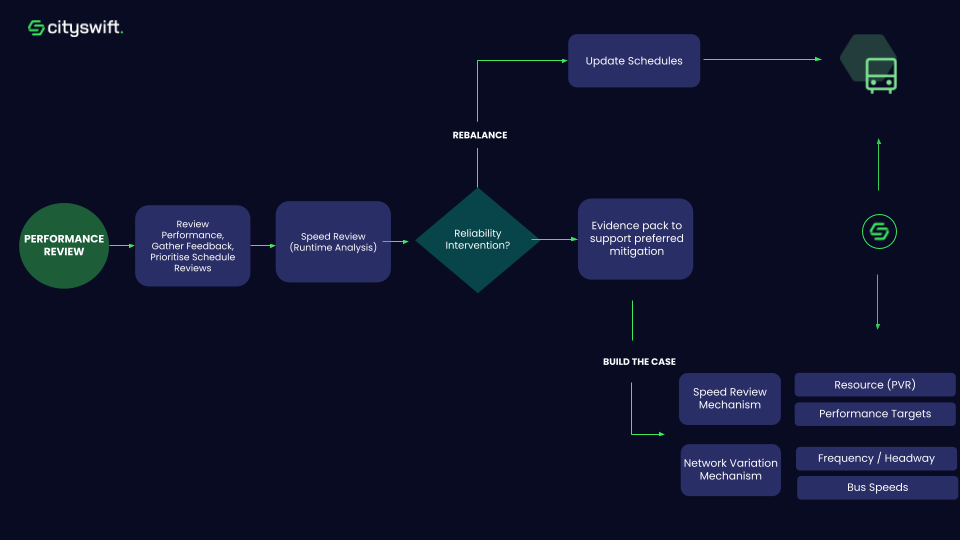
Performance improvements don’t always need to mean increasing costs. The data can uncover cost-neutral opportunities to improve the passenger experience. For example, using stop-level dwell data to identify ‘unneeded dwell time’ where buses are sitting at stops longer than required for boarding. By tightening these windows and redistributing that time to known congestion hotspots, punctuality can be improved while maintaining the PVR and optimising recovery time to avoid knock-on delays between trips.
By using data to inform decision making, you can confidently move minutes from one part of a route to another, keeping the PVR stable while addressing the reliability gap.
Scenario planning example: Managing a timetable that isn’t fit-for-purpose
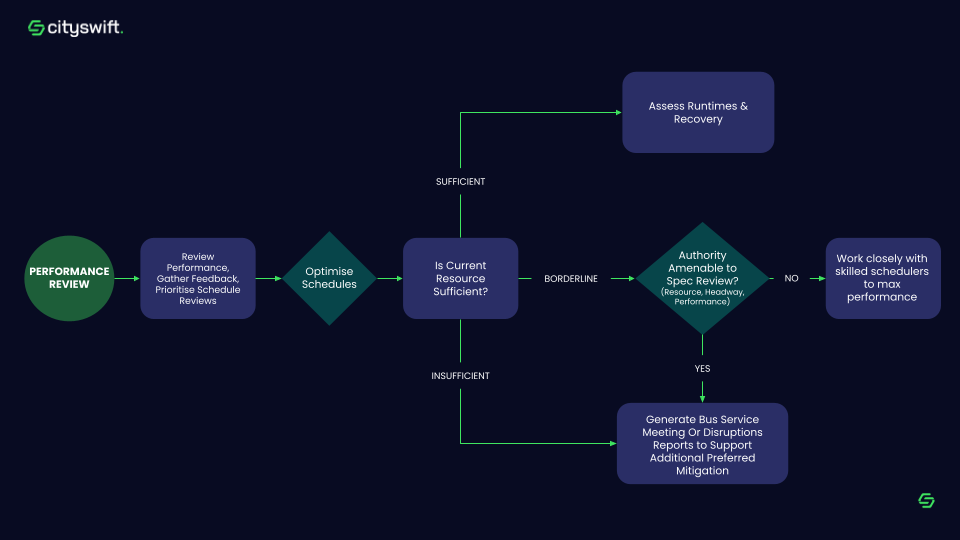
Sometimes, the data shows that the implemented timetable isn’t meeting the network’s demands due to external factors like increased congestion due to roadworks. Simulating alternative schedules can help to make the case for interventions by assessing route performance based on what’s happening on-the-road. While it’s not always the easiest direction as it requires a conversation about widening runtimes, if successful it allows the schedule to be reset to a realistic baseline, reducing driver stress and delivering a better experience for passengers.
You can reach a stage where the available levers are maxed out. For example, if demand is high and congestion is permanent, introducing bus priority or increasing bus capacity could help to mitigate the impact on performance. Data-driven evidence is crucial here; it allows you to demonstrate to the authority exactly why the proposed mitigation strategy is the best way to meet the network’s performance goals.
By comparing the most viable interventions side-by-side, operators can strike a balance that optimally manages runtimes, resources, and passenger demand, while continually improving network performance.
The new standard in operational excellence
Achieving high performance should be a proactive, iterative process. It’s not just about analysing historical performance, it’s about using data to shape future performance.
By balancing runtimes, frequency, and resources, and collaborating through a shared evidence base, operators can deliver a network that is effective for passengers, efficient for the business, and backed by reliable data.
.png)
